Breastfeeding & Nursing · May 22, 2026 · 6 min read
Written by The New Mom Journal Editorial Team · Updated July 20, 2026
Is My Baby Getting Enough Milk? How to Actually Tell
You cannot see ounces moving from one body to another, and that is exactly what makes this the most common 2am worry of early breastfeeding. Unlike a bottle, there is no line on the side to check, so the doubt tends to creep in precisely when you are most tired and least able to reason it away.
The good news is that your baby is giving you data constantly, you just have to know where to look, and the signals are more reliable than they feel in the moment.
The signs that actually matter
Diapers are the most reliable tracker you have, and the pattern follows a predictable curve. Expect one to two wet diapers on day one, two to four by days two and three, four to six by day four, and six or more from day five onward, with pale, nearly colorless urine. Stools follow a similar pattern, dark and tarry on days one and two, shifting to greenish by day three or four, then yellow, loose, and seedy by day five, with at least three to four a day.
6+
wet diapers a day by day five is one of the clearest signs your baby is getting enough milk, alongside steady weight gain after the first week.
What weight gain should look like
Weight is the other big signal. Some loss in the first days is expected and normal, most babies are back to birth weight by two to three weeks, then gaining steadily at roughly five and a half to eight and a half ounces a week until about four months. Frequent feeding, generally eight to twelve times in twenty-four hours, paired with audible swallowing and a breast that feels softer after a feed, rounds out the picture of a baby who is getting what they need.
Comfort while you count diapers
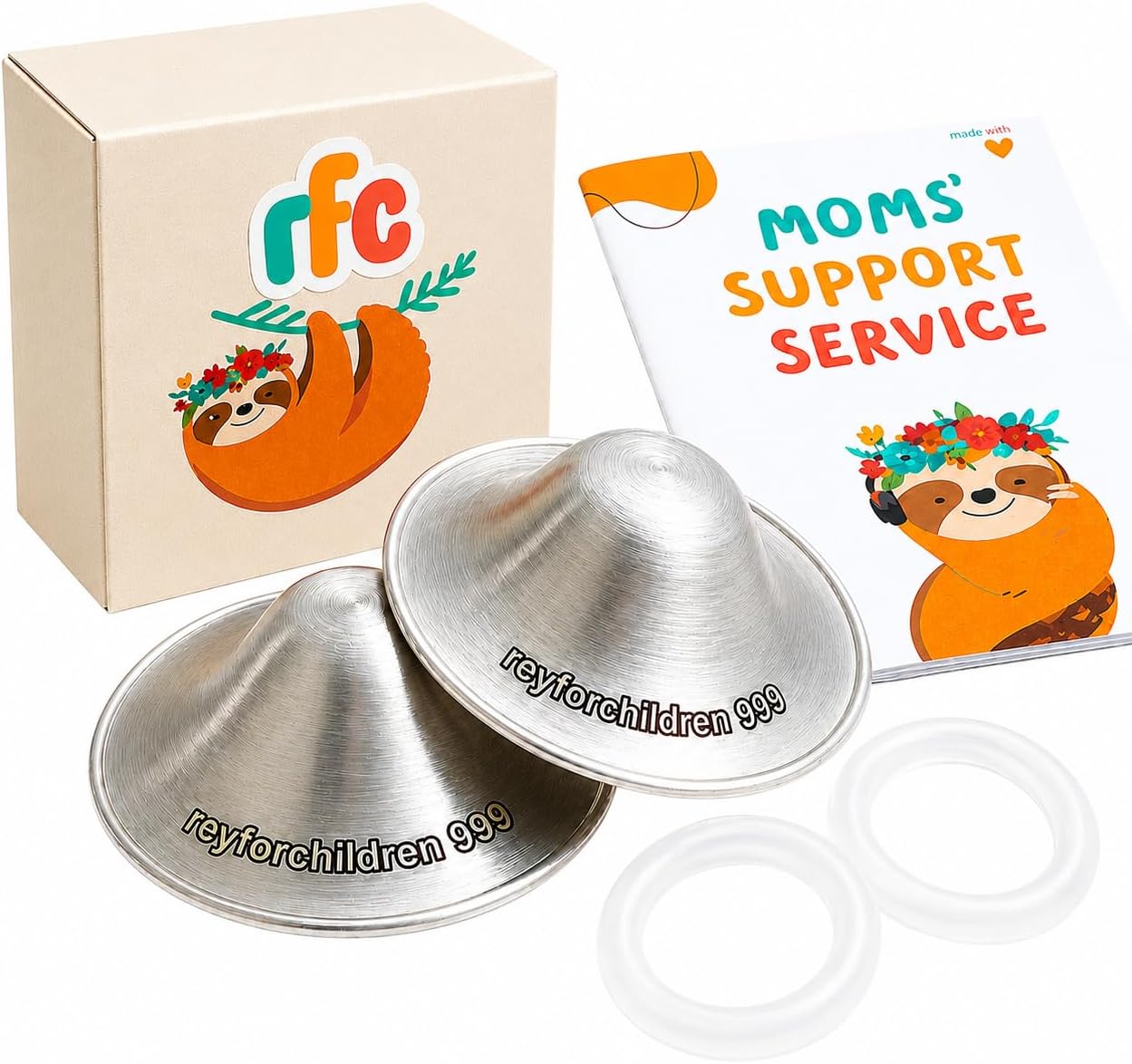
RFC Silver Nursing Cups
Sore nipples can make you dread every feed at the exact moment your baby needs to nurse often. Silver nursing cups help skin recover between sessions, so frequent feeding stays manageable.
If diaper counts are consistently low for your baby's age, feeds seem to leave your baby unsettled rather than satisfied, or weight is not trending up by the two-week mark, that is worth a same-week check with your pediatrician or a lactation consultant, not a wait and see. Caught early, most feeding issues are very fixable, and getting an outside set of eyes on a single feed often answers the question faster than any amount of solo worrying at 2am.
What a lactation consultant checks that you cannot see at home
A feeding assessment typically includes watching your baby latch and suck, checking for audible swallowing, feeling how your breast changes before and after a feed, and sometimes a pre- and post-feed weight check on a specialized scale that can detect ounces transferred during a single session. This kind of direct observation catches subtle issues, a slightly shallow latch, a tongue-tie, weak suck strength, that are difficult to judge from counting diapers alone.
A simple way to actually track it
Trying to hold diaper counts and feed times in your head at 3am is a losing game, write them down instead. A basic notes app entry with the time of each feed, which side, and a quick wet or dirty diaper tally is enough, you do not need a specialized app or spreadsheet. What matters is being able to look back over twenty-four hours and see the pattern rather than relying on memory shaped by exhaustion, which tends to make the last hard feed feel like evidence of a bigger problem than it is.
Many mothers find it reassuring to keep this log for just the first two to three weeks, then stop once a rhythm feels established. If a pediatrician or lactation consultant does get involved, having even a few days of real data on hand makes that visit far more useful than trying to reconstruct the week from memory in the waiting room.
False alarms worth knowing about in advance
A few things commonly get mistaken for a supply problem when they are not one. Cluster feeding in the evenings, where a baby wants to nurse almost constantly for a few hours, is a normal pattern, not a sign your milk has dried up. Breasts that stop feeling full or engorged after the first few weeks are not a sign supply has dropped, that softening is your body calibrating to actual demand rather than overproducing, and it is expected. A baby who suddenly pulls off and fusses partway through a feed is often dealing with a fast letdown or gas, not refusing milk that is not there.
Knowing these patterns in advance does not replace watching diaper counts and weight, but it does mean fewer sleepless hours spent worrying about something that is, more often than not, simply your baby and body finding their rhythm together.
Building confidence in your own read of the situation
Most mothers describe a real turning point where the anxious, constant checking eases, not because the worry was wrong to have, but because a pattern of reliable diaper counts and steady weight gain over a couple of weeks builds genuine trust in what your body and baby are doing together. Each reassuring pediatrician visit adds to that evidence. It is worth actively noticing this shift when it happens, from "I have no idea if this is working" to "I can tell by the fourth diaper of the day", rather than staying on high alert indefinitely out of habit once the early evidence has already answered the question.
Frequently asked questions
How many ounces should a newborn eat per feeding?
In the first few days, half an ounce to an ounce per feed is typical, rising to two to three ounces by the end of the first couple of weeks for bottle-fed babies, breastfed babies self-regulate and do not need ounces tracked the same way.
Can a baby seem full but still be underfed?
Yes, particularly with a shallow latch, a baby can seem satisfied at the breast without transferring enough milk, which is exactly why diaper output and weight matter more than how content a baby appears.
My baby seems satisfied but is not gaining much weight. What does that mean?
A baby can appear content at the breast while still not transferring enough milk, particularly with a shallow latch or an anatomical issue like tongue-tie. Contentment alone is not a substitute for tracking diapers and weight, and this combination is worth a same-week evaluation.
Does pumped output tell me anything about my supply?
Not reliably. Babies are almost always more efficient at removing milk than a pump is, so pumping a small amount does not necessarily mean your baby is getting a small amount. Diaper counts and weight remain far better indicators than how much you can pump.
Can a growth spurt look like a supply problem?
Yes, and this is one of the most common mix-ups. During a growth spurt your baby may want to feed much more often for a few days, which can feel like your supply suddenly is not enough, when it is actually your baby temporarily asking for more, which your body then supplies.
Is it normal to worry about this with every baby, even a second or third?
Very much so. Each baby feeds a little differently, and many experienced mothers describe the same 2am doubt with a second or third baby as they did with their first.
This article shares general information and real-world experience — it isn't medical advice and doesn't replace guidance from your doctor, midwife, or a certified lactation consultant. If something feels off with you or your baby, please reach out to a professional who knows your situation.